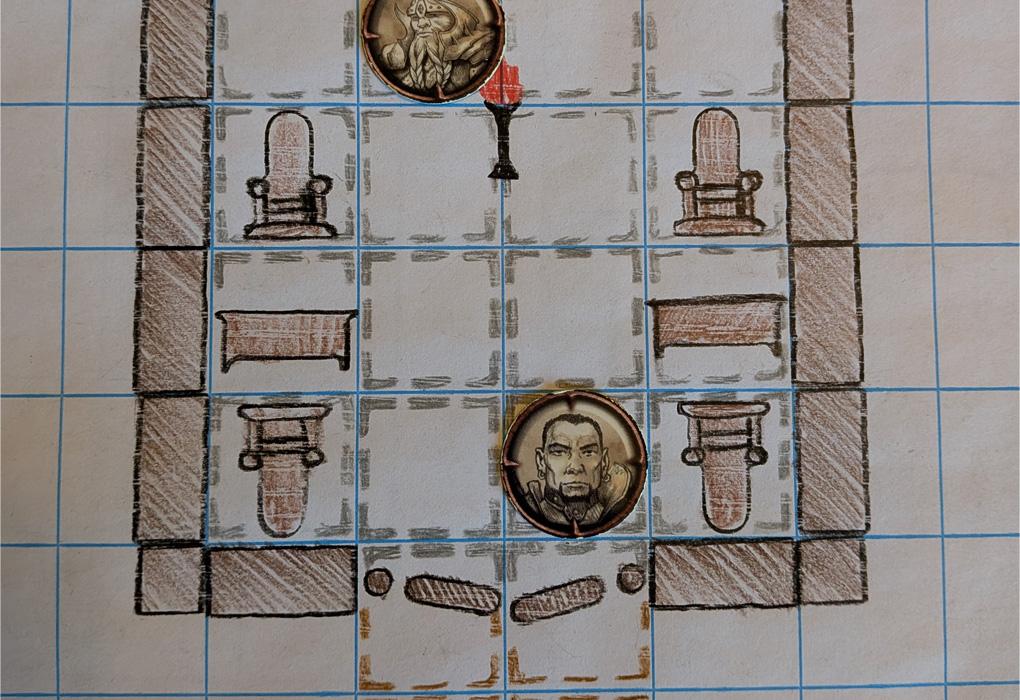
Choosing a D&D battle map tool can be surprisingly difficult.
Printable maps offer detailed artwork. Dungeon tiles can be assembled quickly. Digital map makers provide enormous libraries of terrain and objects. Reusable battle map stencils let you draw custom encounters directly onto a grid.
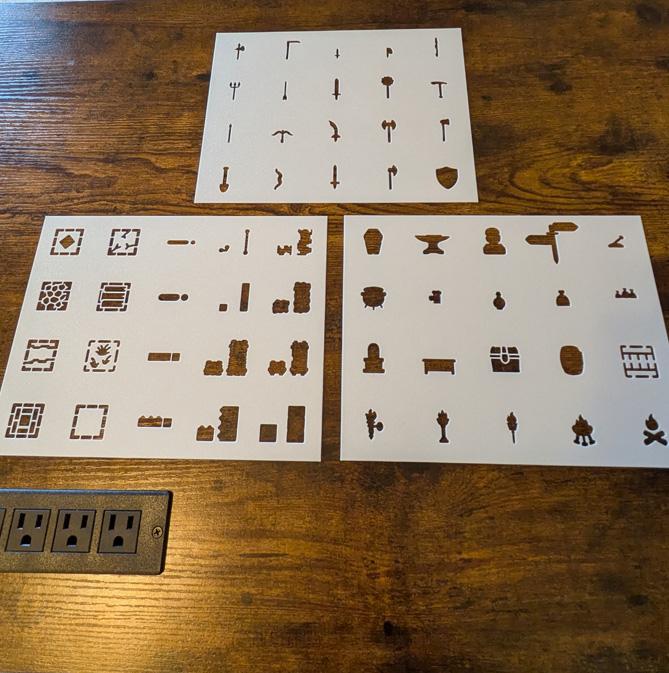
Each option solves a different problem.
The right choice depends on how you prepare your sessions, whether you play in person or online, how often your players surprise you, and how much control you want over the layout.
This guide compares three popular approaches:
- Reusable battle map stencils
- Dungeon tiles and modular terrain
- Digital battle map makers
Rather than declaring one method best for every Game Master, we will examine where each tool works well and where it may create limitations.
Quick Comparison
| Feature | Battle Map Stencils | Dungeon Tiles | Digital Map Makers |
|---|---|---|---|
| Best for | Custom in-person maps | Fast modular layouts | Detailed prepared maps |
| Setup speed | Fast | Very fast | Varies |
| Layout flexibility | High | Moderate | Very high |
| Live improvisation | Excellent | Good | Limited without preparation |
| Visual detail | Simple and readable | Moderate to detailed | Highly detailed |
| Physical storage | Minimal | Moderate to substantial | None |
| Technology required | No | No | Usually yes |
| Works on reusable mats | Yes | Not required | Not directly |
| Easy to customize during play | Yes | Somewhat | Depends on setup |
| Good for online games | Limited | Limited | Excellent |
| Reusable | Yes | Yes | Yes |
| Artistic skill required | Low | None | Low to moderate |
The strongest option often depends on the type of session you are running.
- Choose battle map stencils when you want flexible, hand-drawn maps for in-person play.
- Choose dungeon tiles when you want to assemble physical rooms quickly.
- Choose a digital map maker when you want detailed maps prepared before the session or need maps for online play.
Many Game Masters combine two or all three.
What Are D&D Battle Map Stencils?
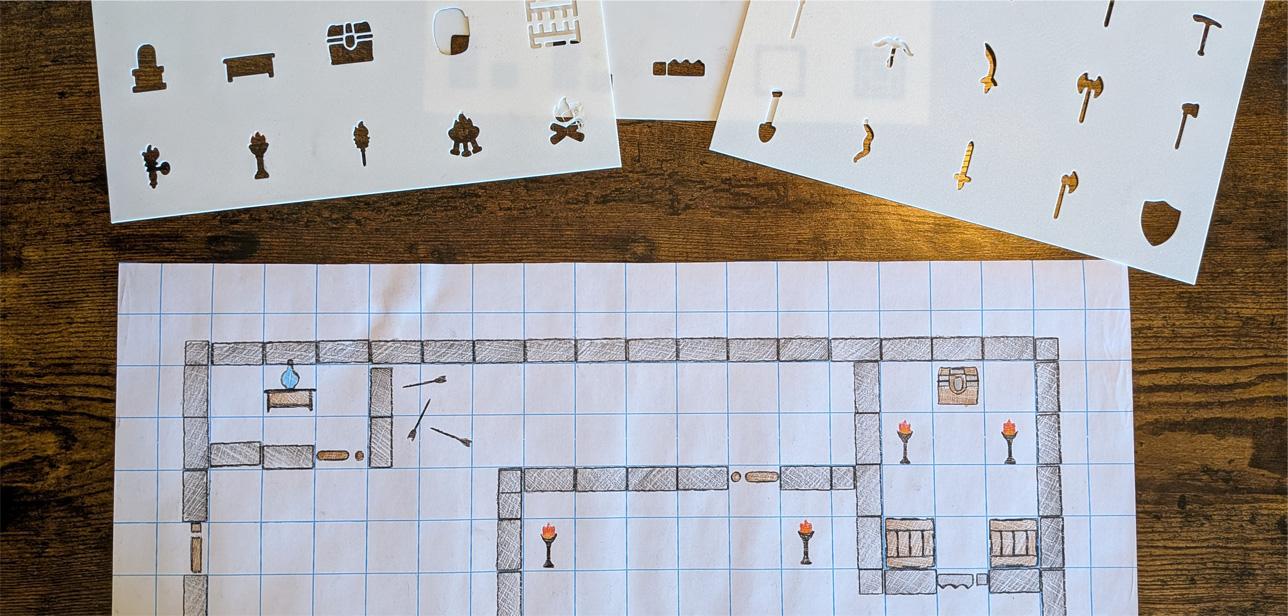
D&D battle map stencils are reusable templates containing cutout shapes for common tabletop map features.
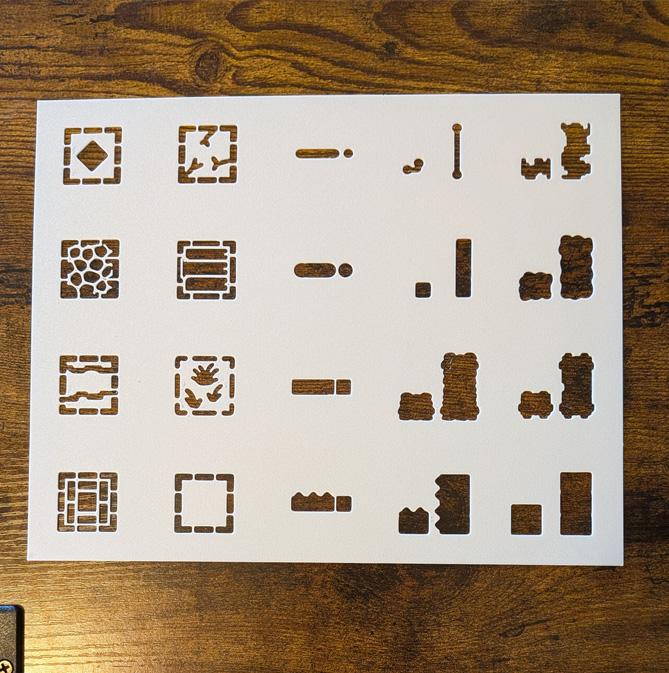
These shapes can represent:
- Walls
- Doors
- Floor patterns
- Furniture
- Barrels and crates
- Weapons
- Treasure
- Torches and fires
- Stairs and ladders
- Traps and hazards
- Environmental details
To use a stencil, place it over a battle mat or sheet of paper and trace through the opening. Move the template around the grid to construct rooms, corridors, buildings, camps, caves, and other encounter areas.
Battle map stencils do not provide a finished map. Instead, they provide reusable components that help you create one.
This makes them similar to a collection of map-building tools rather than a collection of specific locations.
What Are Dungeon Tiles?
Dungeon tiles are physical map sections that can be placed next to each other to create a playable encounter.
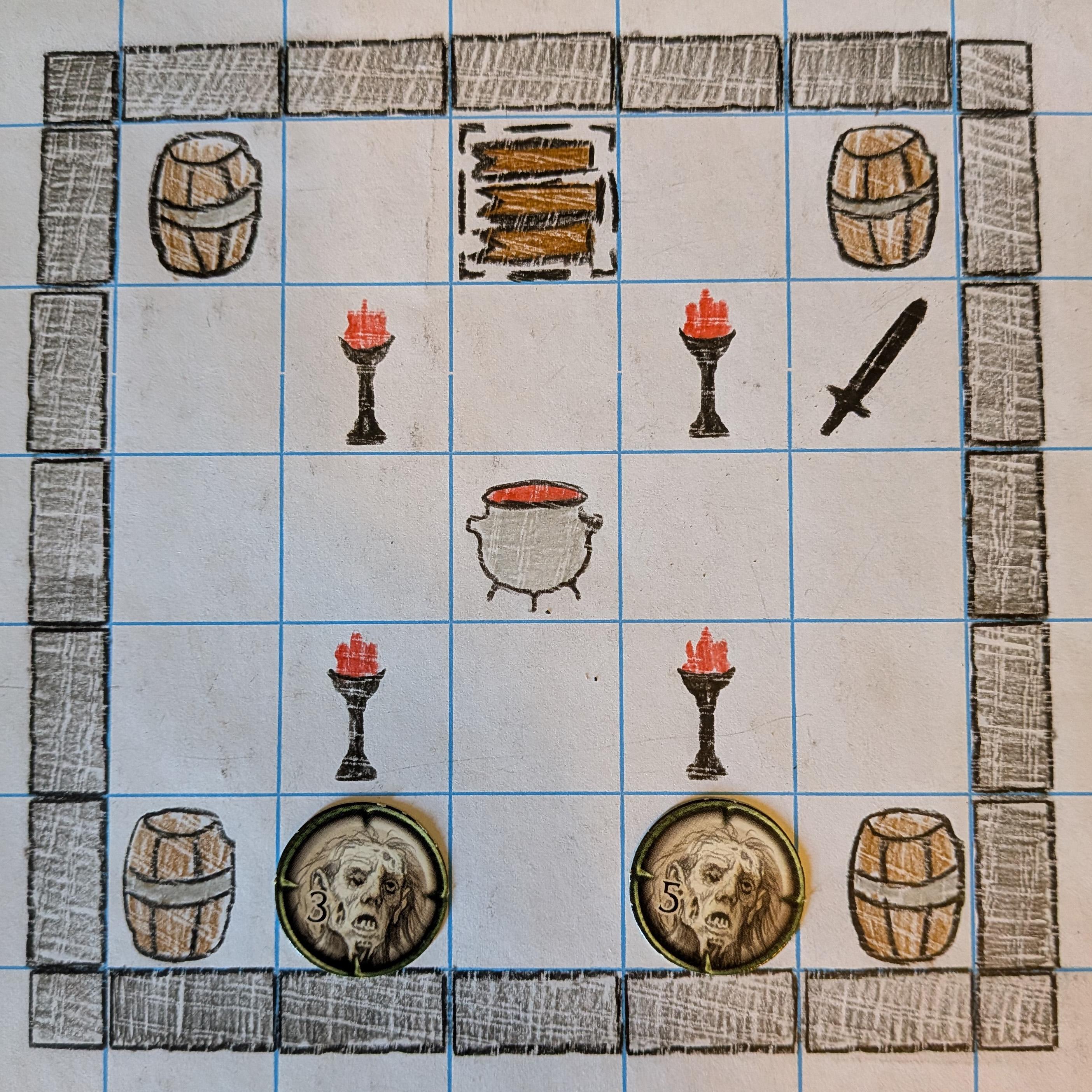
A tile might show:
- A dungeon room
- A corridor
- A cave section
- A forest path
- A building interior
- A river or bridge
- A staircase
- A doorway
- A section of outdoor terrain
Some tiles are made from cardboard or heavy paper. Others are manufactured from plastic, resin, wood, or other durable materials.
Game Masters arrange the tiles on the table to create the required layout. Some sets are flat, while others include walls, doors, furniture, and three-dimensional terrain.
Dungeon tiles are usually designed around modularity. The same room and corridor pieces can be rearranged into different maps.
What Are Digital Battle Map Makers?
Digital battle map makers are applications or websites used to design maps on a computer or tablet.
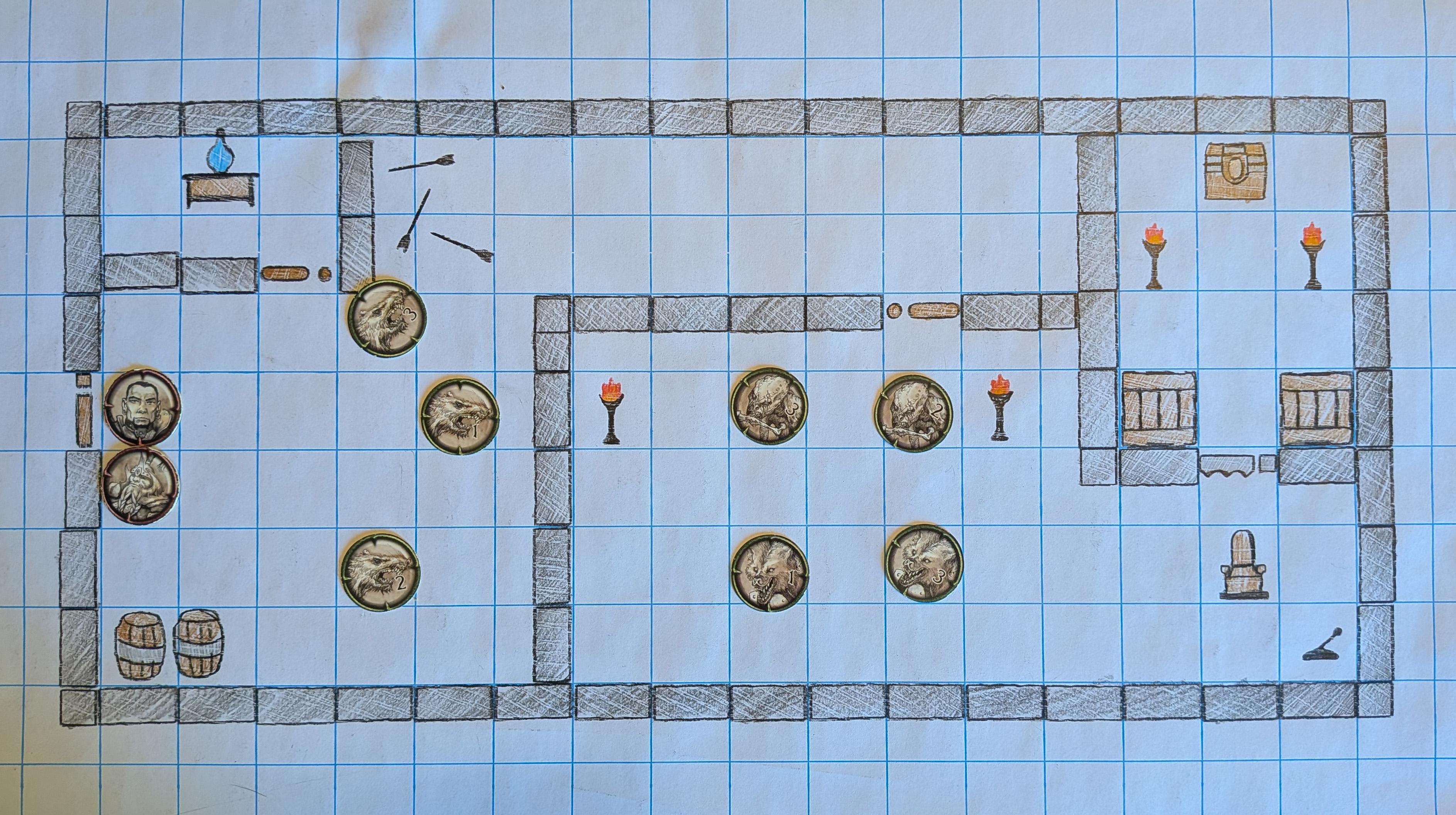
They commonly provide libraries of:
- Terrain textures
- Walls and floors
- Buildings
- Furniture
- Natural features
- Lighting effects
- Objects and decorations
- Grid overlays
- Tokens
- Special effects
A Game Master selects assets, places them on a canvas, and exports the completed map as an image or file.
The map can then be:
- Printed
- Displayed on a television
- Shown on a tabletop screen
- Imported into a virtual tabletop
- Used during an online game
Digital tools can create highly detailed environments, but they usually require more preparation than drawing a simple physical map at the table.
Battle Map Stencils: Advantages and Limitations
Reusable battle map stencils are strongest when speed, flexibility, and physical play are the main priorities.
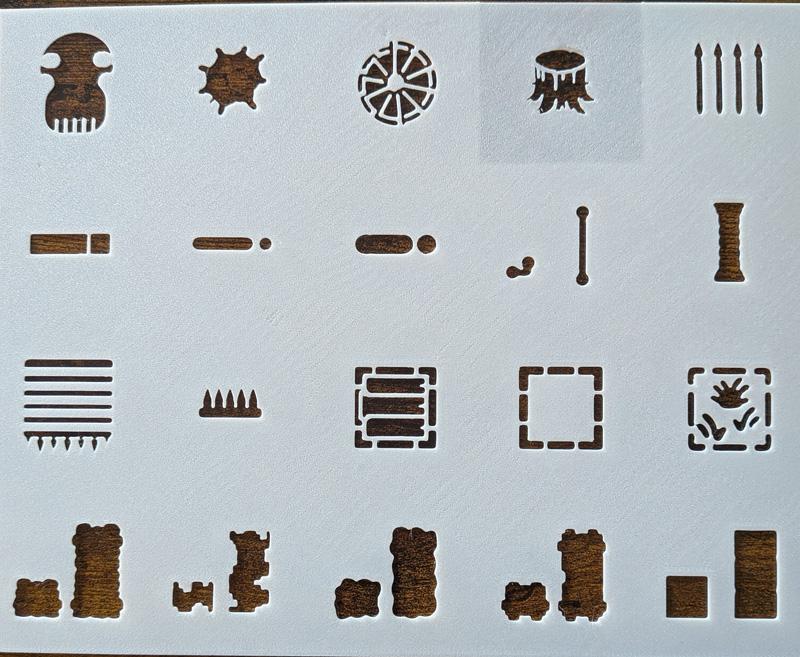
Advantages of Battle Map Stencils
#### You control the complete layout
Stencils do not limit you to a prebuilt room or printed map.
You decide:
- How large the rooms are
- Where the doors are placed
- How corridors connect
- Where furniture appears
- Which areas contain hazards
- How much open space is available
- Which parts of the map are revealed
This is useful when an encounter needs to match a specific adventure rather than a generic location.
#### They work well during improvisation
Players frequently create encounters in locations that were not part of the original plan.
They may attack a merchant inside a shop, follow a suspect into an alley, climb through a castle window, or turn a peaceful tavern conversation into a fight.
With reusable battle map stencils, you can draw the essential layout as the situation develops.
Start with walls and entrances. Add tables, crates, cover, hazards, or other details as they become relevant.
#### They require little storage space
A reusable stencil set can contain many map symbols without requiring boxes of physical terrain.
This can make it easier to transport your mapping tools to another player’s home, a gaming club, a convention, or a public play space.
#### They preserve the hand-drawn experience
Some Game Masters enjoy creating maps by hand but want more consistent results.
Stencils preserve that creative process. You still design the location and make every layout decision, but the individual symbols are faster to draw and easier to recognize.
#### They can be reused for many environments
A crate is not limited to a warehouse. It could appear in a dungeon, tavern, dock, castle, bandit camp, market, or smuggler hideout.
The same principle applies to walls, doors, floors, weapons, fires, tables, and other symbols.
The value comes from combining the pieces in different ways.
#### They do not require power or software
Battle map stencils work without a computer, subscription, television, projector, or internet connection.
You need only a suitable drawing surface and the correct type of marker or pen.
Limitations of Battle Map Stencils
#### They do not provide full-color artwork
Stenciled maps are designed primarily for clarity and speed. They generally will not resemble highly detailed digital illustrations.
Color can be added with multiple markers or pencils, but this requires additional time.
#### Drawing still takes some effort
Stencils make drawing faster, but the Game Master still has to build the map.
Dungeon tiles may be faster when a suitable room can simply be placed on the table.
#### The drawing surface matters
The result depends on the battle mat, paper, marker, and stencil technique.
Always use markers appropriate for the surface and test them in a small area before drawing a complete map.
#### Very large maps take longer
A small encounter can be created quickly. A complete castle, town, or multilevel dungeon requires more time and space.
For large environments, it may be better to draw only the areas where encounters will occur.
Dungeon Tiles: Advantages and Limitations
Dungeon tiles are strongest when quick physical assembly and visual presentation are the main priorities.
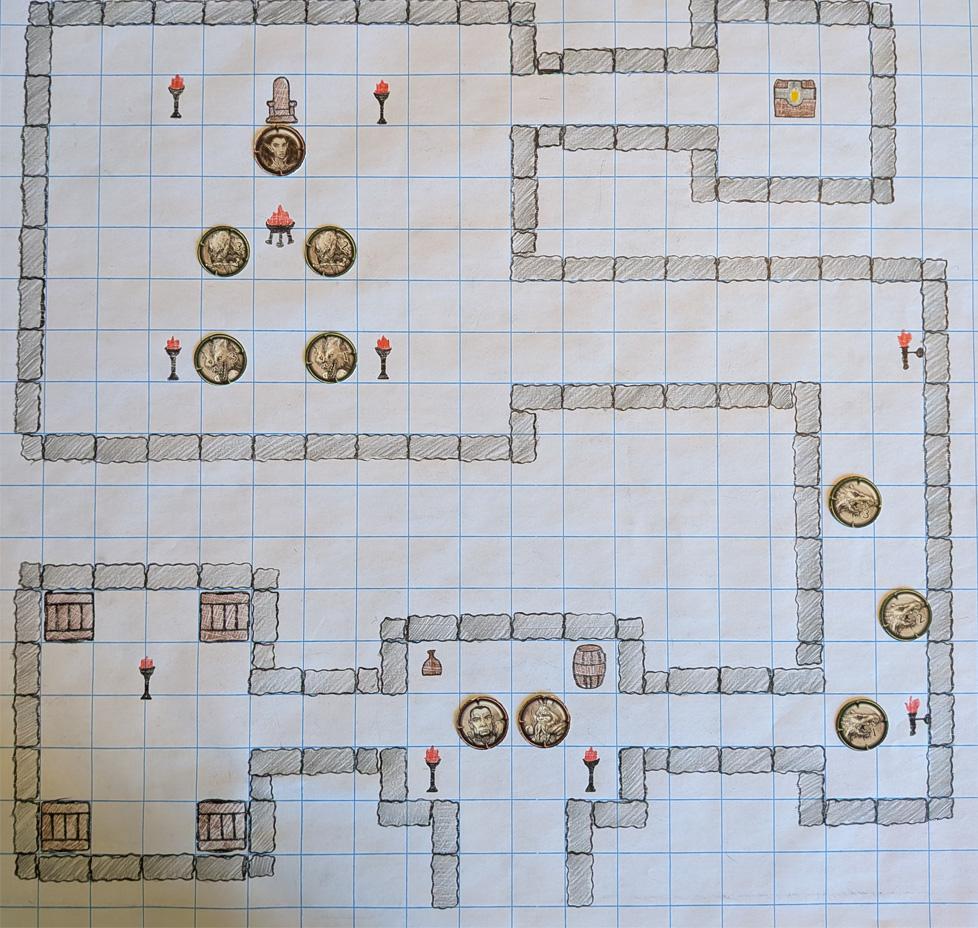
Advantages of Dungeon Tiles
#### They can be placed quickly
A room or corridor can be added to the table in seconds.
If you already know which pieces you need, dungeon tiles can provide one of the fastest methods for building a physical encounter.
#### They require no drawing
The artwork, grid, walls, floors, and terrain are already printed or built into the tile.
This makes tiles approachable for Game Masters who do not enjoy drawing maps.
#### They can look polished
Many tile sets include illustrated floors, shadows, debris, furniture, vegetation, water, lava, or other visual details.
Three-dimensional sets can also give the players a stronger sense of walls, elevation, and distance.
#### Rooms can be revealed gradually
Tiles work well for exploration.
Place new corridors and chambers on the table as the party discovers them. Undiscovered areas remain hidden until they are needed.
#### Physical pieces can feel satisfying
Moving through an assembled dungeon can make exploration feel tangible.
Doors can be opened, rooms can be added, and terrain can be physically rearranged during play.
Limitations of Dungeon Tiles
#### Layouts are limited by available pieces
A tile set may include several useful rooms and corridors, but you can only build layouts supported by the pieces you own.
You may have the correct room shape but not the right doorway placement. You may need a narrow corridor but only have a wide one. You may also run out of corner, wall, or floor pieces.
#### Collections can require significant storage
A small tile set is easy to manage. A large collection of rooms, terrain, furniture, walls, and buildings can require multiple boxes or shelves.
Transporting a complete collection may also be difficult.
#### Tiles can shift during play
Flat tiles may move when players reach across the table or reposition miniatures.
Some Game Masters use adhesive material, frames, or other accessories to keep them aligned.
#### The visual style may not match every location
A stone dungeon tile works well in a dungeon but may not fit a wooden tavern or ruined temple.
Creating multiple environment types usually requires buying or making additional sets.
#### Custom dimensions can be difficult
If the adventure describes a room with an unusual shape or exact dimensions, the available tiles may not reproduce it accurately.
The Game Master may need to approximate the layout.
Digital Map Makers: Advantages and Limitations
Digital battle map makers are strongest when visual detail, online play, and advance customization are the main priorities.
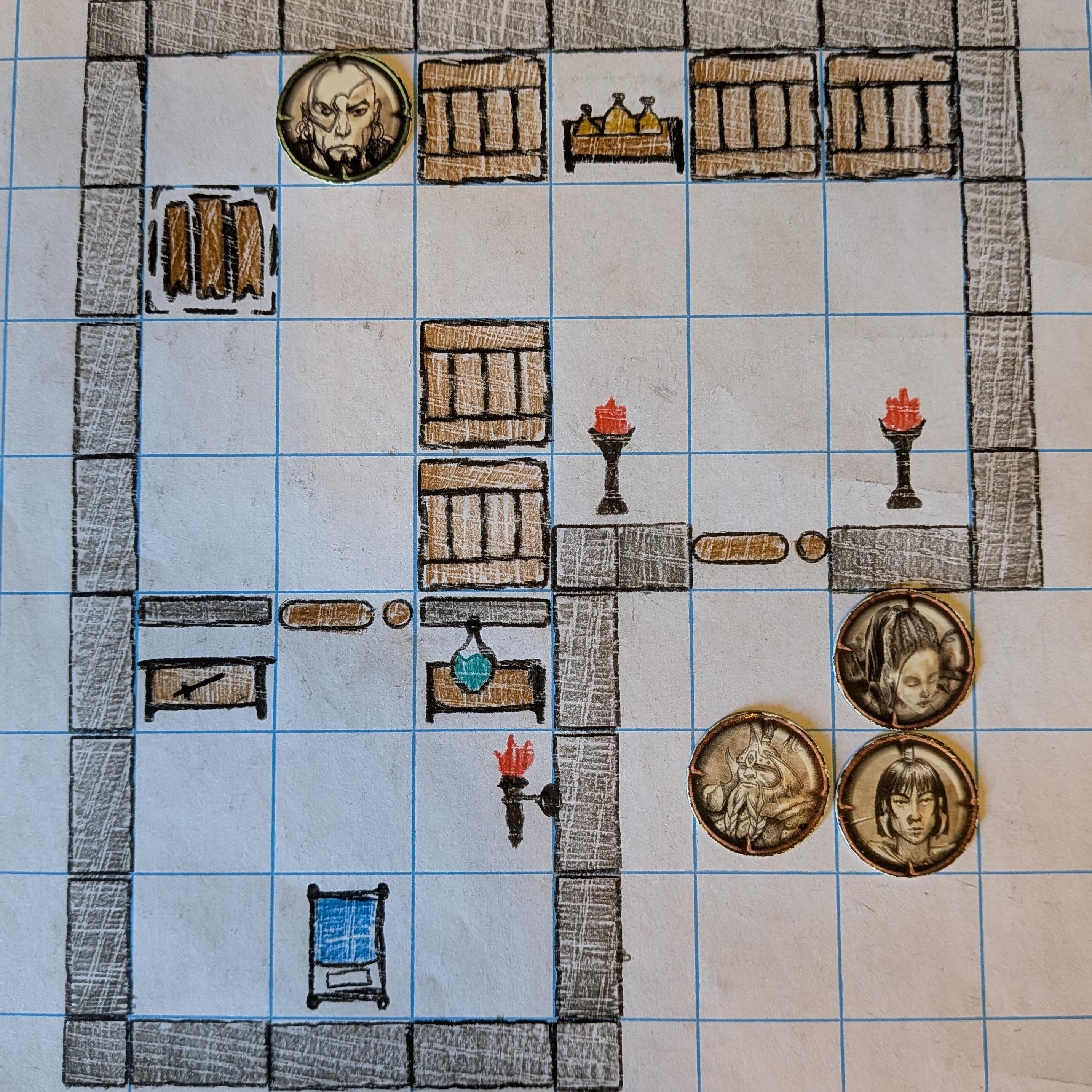
Advantages of Digital Map Makers
#### They offer extensive visual detail
Digital maps can include textures, shadows, lighting, weather, environmental effects, and detailed objects.
A well-prepared digital map can communicate atmosphere immediately.
#### They provide large asset libraries
Digital tools may contain hundreds or thousands of objects and textures.
This allows the Game Master to create many environments without physically storing separate terrain collections.
#### They are highly customizable
Digital maps can be resized, copied, edited, layered, and rearranged.
Walls can be moved, objects rotated, textures replaced, and lighting adjusted without redrawing the entire map.
#### They work well for online games
Digital maps are a natural fit for virtual tabletops and video-based games.
Players can move tokens across the map while the Game Master manages hidden areas, lighting, and other features.
#### Maps can be saved and reused
Once a map is created, it can be stored and used again.
The Game Master can also create several variations of the same location, such as a normal version, a damaged version, and a version covered in fire.
Limitations of Digital Map Makers
#### They can require substantial preparation
Having access to many assets does not automatically make a map fast to build.
Choosing textures, placing objects, adjusting walls, adding lighting, and exporting files can become a significant part of session preparation.
#### Detailed maps can encourage over-preparation
It is easy to spend time decorating spaces the players may never visit.
A Game Master may carefully design an entire building even though the encounter only uses one room.
#### Live changes may be less convenient
If players unexpectedly leave the prepared area, creating a new digital map during the session may interrupt the game.
Simple changes are possible, but building a new location from scratch generally takes longer than sketching walls and objects on a physical mat.
#### Technology becomes part of the setup
Digital maps may require:
- A computer or tablet
- Map-making software
- File storage
- A printer
- A television or projector
- A tabletop display
- A virtual tabletop
- Power and cables
This may be worthwhile for some groups but unnecessary for others.
#### Some tools involve ongoing costs
Certain digital map makers, asset libraries, or virtual tabletop platforms may require purchases or subscriptions.
The total cost depends on the software and content selected.
Which D&D Battle Map Tool Is Fastest?
The answer depends on whether the map has already been prepared.
Fastest prepared option: Dungeon tiles
When the required pieces are organized and ready, dungeon tiles can be placed almost immediately.
The challenge is making sure you own the correct pieces and can locate them quickly.
Fastest custom physical option: Battle map stencils
Reusable stencils are effective when you need a custom room or encounter that does not already exist.
A simple map can be created by drawing:
- Outer walls
- Entrances
- Essential furniture
- Cover
- One hazard or objective
This makes stencils especially useful for improvised encounters.
Fastest detailed option: A saved digital map
A completed digital map can be loaded or printed quickly.
Creating that map in the first place may require more preparation.
Which Option Offers the Most Flexibility?
Digital map makers provide the greatest theoretical flexibility because digital assets can be resized, layered, edited, and duplicated.
However, flexibility during a live in-person session is different from flexibility during preparation.
For live changes:
- Battle map stencils are highly adaptable.
- Dungeon tiles can be rearranged within the limits of the collection.
- Digital maps depend on the available software and display setup.
A Game Master who improvises frequently may value the ability to draw a new doorway immediately more than the ability to create advanced lighting effects before the session.
Which Option Looks Best?
This depends on the desired style.
Choose digital maps for detailed artwork
Digital tools are usually the strongest option for color, lighting, texture, and visual atmosphere.
Choose dungeon tiles for polished physical presentation
Illustrated or three-dimensional tiles provide a finished appearance without requiring the Game Master to draw.
Choose battle map stencils for clean readability
Stencil maps emphasize structure and gameplay information.
Walls, doors, cover, furniture, and hazards can be kept visually distinct without overwhelming the grid.
A map does not need detailed artwork to support an excellent encounter. Players mainly need to understand the space and the choices available to them.
Which Option Is Best for Improvised Encounters?
Reusable battle map stencils are particularly useful when the Game Master must create a location during the session.
Imagine that the players unexpectedly confront a smuggler inside a warehouse.
With stencils, the Game Master can quickly draw:
- Four outer walls
- A loading entrance
- A side door
- Several crates
- Two barrels
- A table
- A ladder
- A raised storage area
- A chest containing evidence
The encounter can begin before every decorative detail is complete.
Dungeon tiles can also support improvisation if the collection contains suitable warehouse pieces. A digital map may work if a generic warehouse has already been prepared or downloaded.
Which Option Is Best for Online D&D?
Digital map makers are generally the strongest choice for online games.
They allow Game Masters to create maps that can be imported into virtual tabletops, shared on screen, or used with digital tokens.
Battle map stencils and dungeon tiles are primarily physical tools. They can still be used online by photographing or recording the table, but they are not designed specifically for virtual play.
Which Option Is Best for In-Person D&D?
All three can work for in-person games.
The choice depends on your setup:
- Use battle map stencils with a reusable mat for flexible, hand-drawn encounters.
- Use dungeon tiles for fast physical assembly.
- Use digital maps with a television, projector, tabletop screen, or printed copy.
For a portable setup with minimal equipment, battle map stencils and a folding battle mat may be easier to transport than a large terrain collection or digital display.
Comparing the Cost Over Time
The cost of each method depends on how deeply you invest in it.
Battle map stencils
Common expenses may include:
- The stencil set
- A reusable battle mat
- Markers
- Cleaning supplies
- Paper, when applicable
Once purchased, the same stencil pieces can be reused across many different encounters.
Dungeon tiles
Common expenses may include:
- Basic room and corridor sets
- Additional environment sets
- Doors and walls
- Furniture
- Three-dimensional terrain
- Storage containers
- Carrying cases
A basic tile collection may be affordable, while a large terrain library can become a significant investment.
Digital map makers
Common expenses may include:
- Software
- Subscriptions
- Asset packs
- Printing
- Ink and paper
- A display screen
- Virtual tabletop services
Some digital tools are free, while others use one-time purchases or recurring plans.
The best value is not necessarily the option with the lowest initial price. It is the tool you will use regularly.
Do Battle Map Stencils Replace Dungeon Tiles?
Not necessarily.
Battle map stencils and dungeon tiles can work together.
For example, you might use dungeon tiles for the main rooms and draw custom connecting corridors with stencils. You could place a physical staircase tile inside a room drawn on a reusable mat or use stenciled symbols to add objects missing from a tile set.
Stencils can fill gaps when the available tiles do not match the required layout.
Do Battle Map Stencils Replace Digital Maps?
They solve different needs.
A digital map may be ideal for a major encounter that has been planned for several sessions. A stencil map may be better for a random encounter, an unexpected location, or a room that needs to match exact dimensions from the adventure.
Using both allows a Game Master to choose how much preparation each encounter deserves.
A Hybrid Battle Map Setup
Many Game Masters do not need to choose only one system.
A practical hybrid setup might include:
- Reusable stencils for improvised and custom maps
- A small dungeon tile collection for common rooms
- Digital maps for major set-piece encounters
- Physical terrain for important interactive objects
- Printed maps for recurring locations
For example, a campaign session might use:
- A digital map for the final temple battle
- Dungeon tiles for the crypt beneath the temple
- Battle map stencils for an unexpected roadside ambush
- A few physical crates and miniatures for added depth
Each tool is used where it provides the most value.
How to Choose the Right D&D Battle Map Tool
Ask yourself the following questions.
Do you play primarily online or in person?
For online games, digital maps are usually the most convenient.
For in-person games, all three methods are practical.
How much preparation do you enjoy?
Digital map making can become a creative hobby of its own.
Dungeon tiles reduce drawing and design time. Battle map stencils offer a middle ground by making hand-drawn maps faster without removing creative control.
How often do your players surprise you?
Groups that frequently explore unexpected locations benefit from tools that can adapt during play.
Battle map stencils are particularly helpful for this style of game.
How much storage space do you have?
Digital maps require no physical storage. Stencils require very little. Large dungeon tile and terrain collections may require dedicated storage.
How important is visual detail?
Use digital maps or illustrated tiles when rich visual presentation is a priority.
Use stencils when clear gameplay information and flexible layouts matter more than detailed artwork.
Do you travel with your game supplies?
A stencil set, markers, and a folding mat can provide a portable mapping system.
Large tile and terrain collections may be harder to transport.
When Battle Map Stencils Are the Best Choice
Reusable battle map stencils may be the best option when you:
- Run games in person
- Use a dry-erase or wet-erase battle mat
- Frequently improvise encounters
- Want complete control over room dimensions
- Need maps that match specific adventure layouts
- Prefer hand-drawn maps
- Have limited storage space
- Want reusable mapping tools
- Travel with your game supplies
- Need a fast way to add recognizable details
Stencils are especially useful for Game Masters who want to create rather than simply display a finished map.
When Dungeon Tiles Are the Best Choice
Dungeon tiles may be the best option when you:
- Want rooms that can be placed immediately
- Do not enjoy drawing
- Like modular physical components
- Want to reveal areas as the party explores
- Have storage space for a tile collection
- Regularly use similar dungeon layouts
- Enjoy combining maps with physical terrain
When Digital Map Makers Are the Best Choice
A digital map maker may be the best option when you:
- Play online
- Want detailed color maps
- Enjoy designing locations before the session
- Use a virtual tabletop
- Display maps on a screen
- Print maps for important encounters
- Want large digital asset libraries
- Need to save, copy, and edit maps between sessions
Build Flexible Encounters with RPG Stencils
RPG Stencils are designed for Game Masters who want to build clear, custom battle maps without drawing every object from scratch.
Use reusable walls, floors, doors, furniture, weapons, treasure, lighting, and environmental details to create:
- Dungeons
- Taverns
- Castles
- Crypts
- Caves
- Camps
- Warehouses
- Hideouts
- Town buildings
- Outdoor encounters
You can prepare the map before the session or build it one room at a time as the players explore.
Dungeon tiles and digital map makers remain useful tools. Reusable battle map stencils provide another option: a compact, flexible system for turning an empty grid into the location your adventure actually needs.
Frequently Asked Questions
What are the best tools for drawing D&D battle maps?
Useful D&D battle map tools include reusable stencils, dry-erase or wet-erase mats, dungeon tiles, digital map-making software, printable maps, markers, terrain, and tokens. The best combination depends on whether you play online or in person and how much preparation you prefer.
Are battle map stencils worth using?
Battle map stencils can be worthwhile for Game Masters who run in-person games, improvise frequently, and want reusable tools for creating custom layouts. They provide more freedom than fixed maps while making common features easier to draw.
Are dungeon tiles faster than drawing a map?
Dungeon tiles can be faster when the correct pieces are already organized and available. Stencils may be faster when you need a custom layout that your tile collection cannot reproduce.
Are digital maps better than physical battle maps?
Digital maps are often better for online games and detailed visual presentation. Physical maps may be more convenient for groups that prefer miniatures, direct interaction, and a low-technology tabletop setup.
Can I use battle map stencils with dungeon tiles?
Yes. Stencils can add connecting corridors, custom room sections, furniture, hazards, or environmental details around existing dungeon tiles.
Can I combine digital and physical maps?
Yes. A digital map can be printed or displayed on a tabletop screen, then combined with physical miniatures, tokens, terrain, or other accessories.
Which battle map tool is best for improvisation?
Reusable stencils and simple drawing tools are particularly effective for improvisation because the Game Master can create a custom location immediately. Dungeon tiles can also work well when suitable pieces are available.
Which battle map tool requires the least storage?
Digital maps require no physical storage. Reusable stencils require little physical space compared with most dungeon tile or three-dimensional terrain collections.
Do battle maps need detailed artwork?
No. A battle map primarily needs to communicate walls, movement paths, terrain, cover, hazards, and objectives. Clear, simple symbols can be more useful during play than heavily decorated artwork.
Can reusable stencils be used for games other than D&D?
Yes. Battle map stencils can be used for many fantasy tabletop role-playing games that use grids, miniatures, tokens, or hand-drawn encounter maps.