What Makes a Rogue Hideout Feel Like a Hideout?
A dungeon is built to exist. A hideout is built to work.
Players should immediately feel:
- someone lives here (mess, supplies, routines)
- someone controls this space (small doors, chokepoints, branching routes)
- someone hides things (stash rooms, dark corners, misdirection)
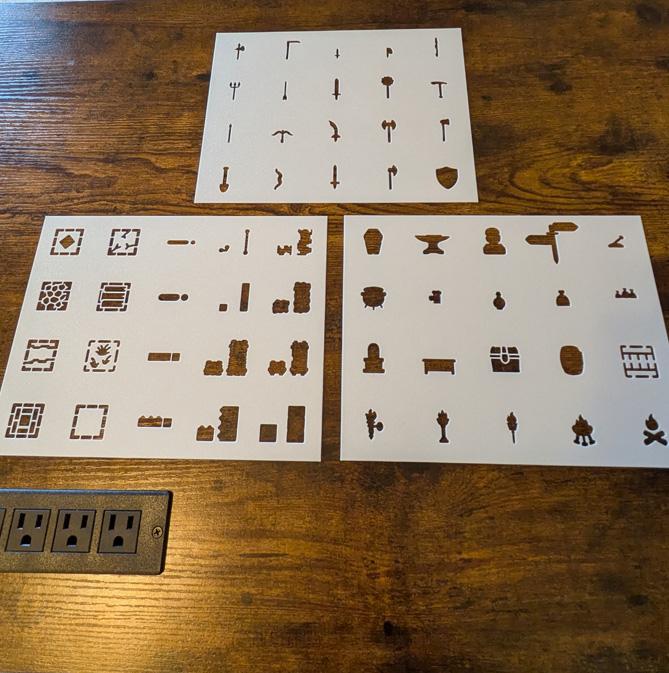
Stencil-wise, your hideout “language” is simple:
- Wood Wall = patched construction, beams, makeshift rooms
- Stone Wall / Cobble Wall = stolen city infrastructure (basements, old underworks)
- Small Door = controlled access, secrecy, “not meant for public travel”
- Crate / Chest / Bags / Bag / Bags on table = life and loot
- Wall Torch / Standing Torch = activity signals (or intentional darkness)

# The Hideout Flow (Entrance → Staging → Stash → Escape)
If you build nothing else, build this flow. It’s the backbone of “secret vibes.”
1) Entrance: The Disguise Layer
Your entrance should feel like it could be missed:
- narrow access
- a small antechamber
- minimal light (or a single torch that looks “placed”)
Stencil recipe
- Walls: Cobble Wall or Stone Wall (it’s part of the city)
- Door: Small Door (controlled entry)
- Light: one Standing Torch (temporary) *or* no torch at all (more secret)
> Tip
> Darkness is a clue. If the entrance has no torch, players assume “this is hidden on purpose.”
2) Staging Room: Where the Crew Works
This is the “people are here” room: planning, sorting, quick meetings.
Stencil recipe
- Walls: Wood Wall (patchwork additions)
- Props: Bags on table (counting coin, checking goods)
- Extras: a couple Crates for “busy storage”
- Light: Wall Torch if it’s a permanent base, Standing Torch if it’s temporary
3) Stash Room: The Real Reason Players Are Here
A stash room should be instantly obvious and instantly tempting.
Stencil recipe
- 1–2 Chests (the “this matters” icon)
- Bags and a Bag nearby (coin sacks, supplies)
- A couple Crates for cover and storage
- Light: either no torch (hidden stash) or one wall torch (guarded stash)
4) Escape Route: The “Oh No” Tunnel
An escape route should be:
- simple
- readable
- slightly suspicious
Stencil recipe
- Walls: Stone Wall (old tunnel) or Wood Wall (newly cut)
- Doors: Small Door at the end (tight exit)
- Light: minimal (one torch at most)
Wall Language: Built vs Borrowed vs Stolen
Hideouts are at their best when different rooms feel like different eras.
Use this quick logic:
- Cobble Wall near the entrance (city underworks)
- Stone Wall in older tunnels (historic infrastructure)
- Wood Wall in living/work areas (patched, built, expanded)
> Tip
> Mix wall types in the same hideout. It tells a story without writing a single word.
Small Doors: The Hideout’s “Control Switch”
A hideout feels secret because it feels controlled. The Small Door is your best control tool.
Small door conventions that feel right
- Put small doors at angles and offsets (not perfectly centered)
- Use small doors to create airlocks (door → tiny hall → door)
- Make the stash room require passing at least two small doors (secrecy layers)
> Warning
> If every room has a door, the map feels like an office. Use doors to *control* access, not to label rooms.
# Two Key Patterns (Copy/Paste Into Any Hideout)
These are “drop-in” blocks you can stencil into any room.
Pattern 1: The Contraband Corner
This pattern says: “illegal goods are here” instantly.
Stencil recipe
- 2 Crates (stacked goods)
- 1 Bag + Bags (loose supplies / coin)
- 1 Chest (the valuable item)
- Light cue:
- Standing Torch if someone is actively working
- No torch if it’s meant to be missed
How it plays
- obvious loot without needing narration
- creates cover (crates) and temptation (chest)
- easy to defend if enemies hold the corner
Pattern 2: The Stash Room (Loot + Tactics)
A stash room should be readable and playable—no clutter maze.
Stencil recipe
- 1–2 Chests placed along a wall (storage behavior)
- 2–3 Bags around the chests (coin, supplies)
- 1–2 Crates for tactical cover (not in the center)
- Optional: Bags on table if it’s an “inventory / planning” stash
How it plays
- players can move freely (center stays open)
- loot is obvious
- cover exists without blocking lanes
> Tip
> If the stash room is meant to be trapped, leave it too clean—one chest, one torch, nothing else. Players will immediately suspect something.
Lived-In Details Without Drawing More Stuff
You don’t need 20 unique props. You need *signals*.
Use these “micro-signals”:
- Bags on table = active work, counting, planning
- Standing Torch = someone is here now
- Wall Torch = long-term base
- Crates near doors = “ready to move” goods
- Bags near exits = “grab-and-go” supplies
Common Hideout Mistakes (Easy Fixes)
- Everything is lit: make at least one room intentionally dark.
- Too many chests: one chest is more tempting than five.
- Props everywhere: cluster in corners, leave the center clear.
- No escape route: add a simple back tunnel—even if it’s locked.
Next Steps
To expand this hideout into a full undercity mini-dungeon:
- connect the escape route to a Stone Wall tunnel network
- add a “guard checkpoint” room using Crates as cover
- turn one side room into a stash puzzle by swapping lighting: no torch until the door opens, then standing torch appears (someone was just here)
When you combine wall language, small door control, and stash patterns, your hideout will feel believable—and play fast.